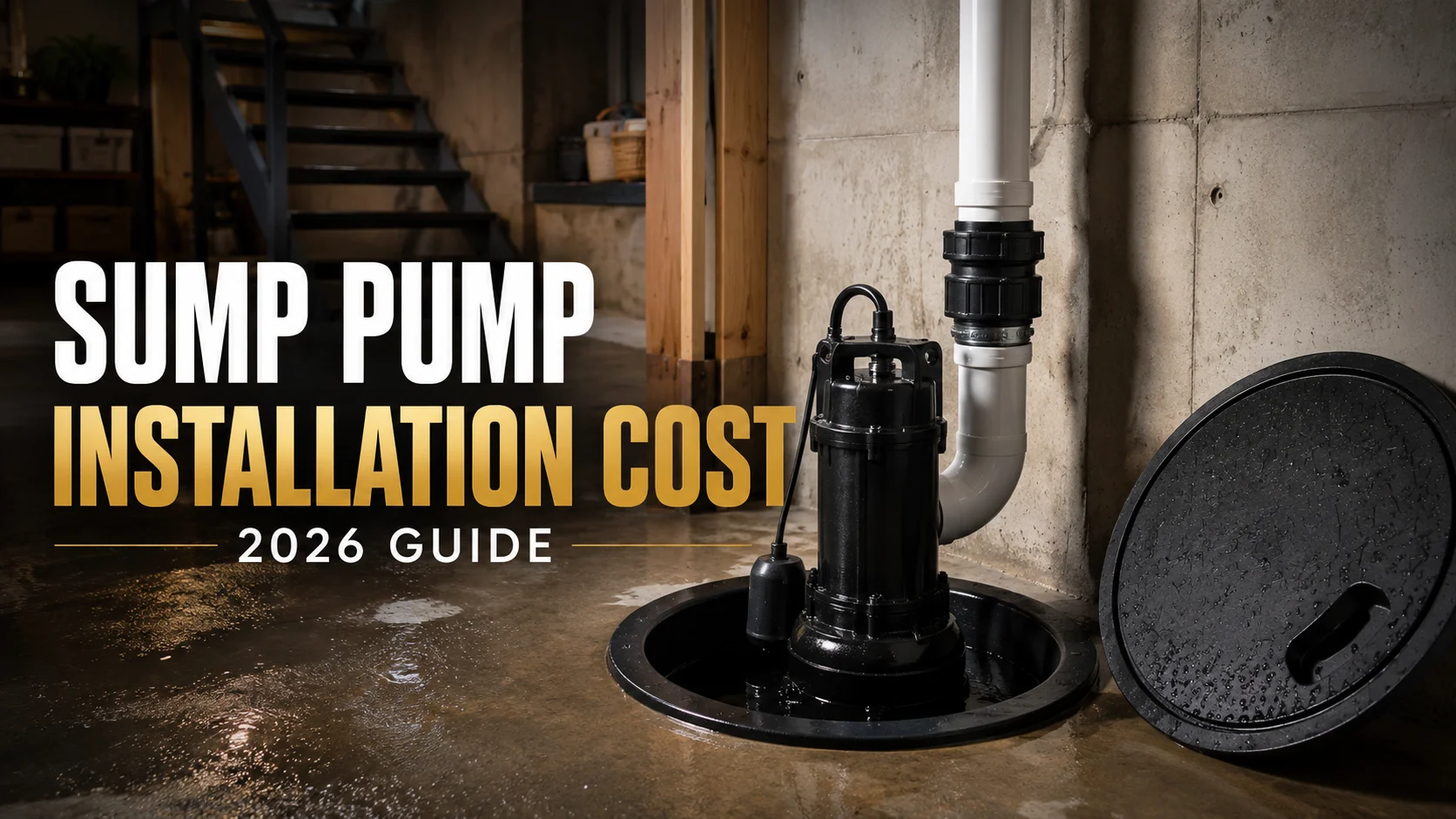
Basements that flood once tend to flood again. The pump sitting in the floor is the cheapest part of that fix, and it is also the part most owners price last. Quotes we tracked through 2026 run from a few hundred dollars for a straight swap to several thousand for a first system in a finished space. This guide splits the sump pump installation cost into the line items a plumber actually writes on the bid.
How much does sump pump installation cost?
Most homeowners pay $600 to $3,000 in 2026, with a national midpoint near $1,400. Swapping a failed unit into a pit that already exists lands at $450 to $900. Cutting a fresh pit through a concrete floor, running discharge pipe and adding a circuit pushes a first install toward $2,500.
| Setup | Installed price we saw in 2026 | Who it suits |
|---|---|---|
| Pedestal pump, existing pit | $500 to $1,200 | Light seepage, shallow pits |
| Submersible pump, existing pit | $700 to $1,600 | Most finished basements |
| New pit cut into a concrete floor | $1,500 to $3,000 | Homes with no pit yet |
| Battery backup added | $900 to $2,000 | Areas with frequent outages |
| Water powered backup added | $1,200 to $2,500 | Homes on city water pressure |
| Crawl space or exterior pit | $1,500 to $4,000 | Tight or awkward access |
Those numbers assume one pit and one discharge run. Got two low corners? You need two pits, and the second one rarely costs half as much as the first. Water coming through the wall is a different problem from water rising through the slab. Read our notes on stopping water leaks in a basement first, because a pump moves water it cannot prevent.
Key takeaways
- Typical 2026 range: $600 to $3,000 installed, midpoint around $1,400.
- Labor is the bigger half of most bids, at $75 to $150 an hour.
- A like for like swap in a good pit is a $450 to $900 job, not a project.
- Breaking concrete for a new pit adds $500 to $1,200 on its own.
- Budget $250 to $900 more if there is no dedicated outlet near the pit.
- Owning one runs about $2,600 to $4,500 across ten years, replacements included.
What the quote actually pays for
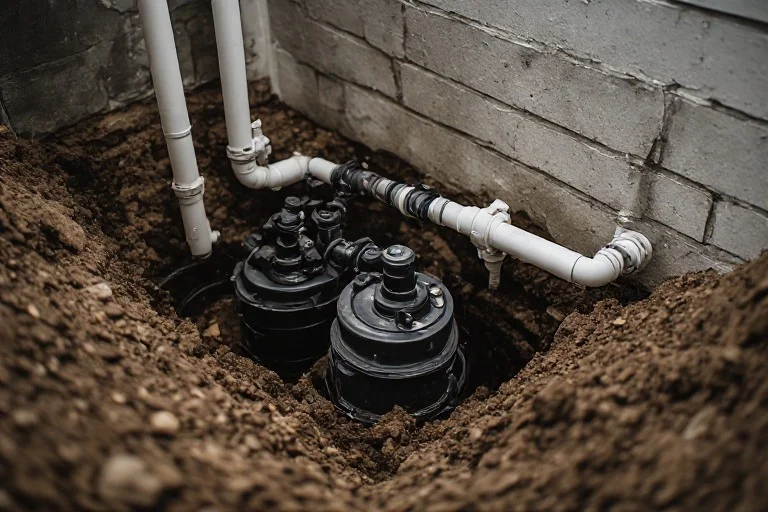
Contractors quote a single number, so the parts stay invisible until something changes mid job. Here is how a $1,900 bid we reviewed this spring broke down.
| Line item | Share of the bid | Typical range |
|---|---|---|
| Pump unit, half horsepower | $260 | $120 to $800 |
| Basin, cover and check valve | $180 | $90 to $400 |
| Breaking and digging the pit | $620 | $500 to $1,200 |
| Discharge pipe and exterior outlet | $310 | $150 to $800 |
| Concrete patch and cleanup | $190 | $100 to $350 |
| Debris haul away and permit fee | $140 | $50 to $300 |
| Labor, roughly seven hours | $200 margin above the above | $75 to $150 per hour |
Ask for that breakdown in writing. Bidders who will not itemize can move the total later, and the pit dig is where that movement almost always happens. Push back once and you will learn a lot about the company.
Pedestal or submersible: which is worth the money
These are the two real options for a home, and they are not close in price or in service life. Pedestal units keep the motor on a post above the water. Submersibles sit down in the basin, hidden under the lid, and run cooler under load because the water around them carries the heat away.
| Pedestal | Submersible | |
|---|---|---|
| Installed price | $500 to $1,200 | $700 to $1,600 |
| Service life | Around 25 years for the motor | 7 to 12 years |
| Noise | Loud, the motor is in the room | Muffled by water |
| Capacity | Modest, 1,500 to 2,500 GPH | 2,000 to 5,000 GPH |
| Pit needed | Narrow pits are fine | Needs an 18 inch basin |
Pedestal pros and cons: cheaper up front, easy to service, long motor life. Against that, it is noisy, it cannot handle heavy inflow, and the exposed motor is awkward in a finished room.
Submersible pros and cons: quiet, hidden under a sealed lid, and strong enough for a bad storm. Against that, it costs more, it demands a wider basin, and replacing it means reaching into the pit.
Backup pumps and what they add
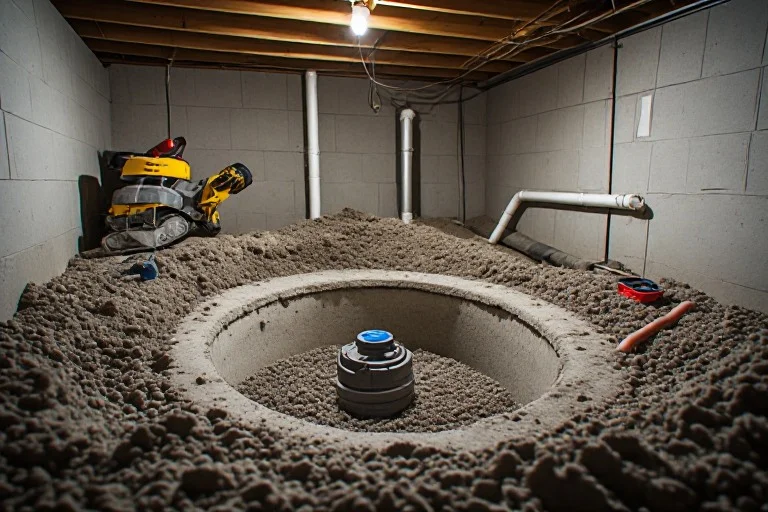
Storms knock out power and pumps quit exactly when the yard is saturated. Battery backups add $900 to $2,000 installed and buy you roughly six to eight hours of pumping. Cheaper kits exist near $300. Their small chargers struggle after the first long outage, which is the outage that matters.
Water powered backups run $1,200 to $2,500. They use municipal supply pressure instead of a battery, so nothing ever needs charging. It only works on city water, and it burns about two gallons of supply for every gallon it clears. Well water homes should skip it.
The costs that catch people out
Three items land after the estimate on jobs we have seen, and none of them appear in the headline price on page one of search results.
- A dedicated circuit. Older basements often have no grounded outlet within reach of the pit. An electrician charges $250 to $900 to run one, plus $150 to $350 for a GFCI receptacle.
- Freeze protection. In cold states the discharge run needs insulation, a freeze relief fitting, or a slope that drains itself after every cycle. Figure $80 to $300 extra.
- Discharge distance. Most towns want the outlet at least ten feet from the foundation. Burying that pipe to a proper daylight point costs $250 to $2,000 depending on the yard.
Permits are a smaller line, usually $50 to $250. Many towns skip them unless the work touches wiring or the storm sewer. Call the building office first. Assuming you are exempt is how a finished job fails a resale inspection later.
Replacing versus starting from scratch
Replacement is the cheap path because the expensive hole already exists. Pulling a dead unit, fitting a new one and testing the float runs $450 to $900 all in, and the crew is usually gone inside two hours. Keep the old basin if it is intact and the cover still seals.
Starting from scratch means a saw, a jackhammer and gravel. That is why the first system in a house runs $1,500 to $3,000, and why the same pump costs triple to put in the first time. If your slab is thick or reinforced, expect the upper end.
Where you live moves the price
| Region | Typical installed price | Why |
|---|---|---|
| Northeast metros | $1,600 to $3,200 | High labor rates, old stone foundations |
| Pacific coast | $1,500 to $3,000 | Permit steps and travel time |
| Midwest | $900 to $1,900 | Deep competition, plenty of basements |
| Southeast | $800 to $1,700 | Crawl spaces, less concrete to cut |
The gap between a Boston bid and an Indianapolis bid on identical work is roughly 30 percent. Almost all of that gap is the hourly rate rather than the hardware. Worth knowing before you call a local quote too high.
DIY or hire a pro
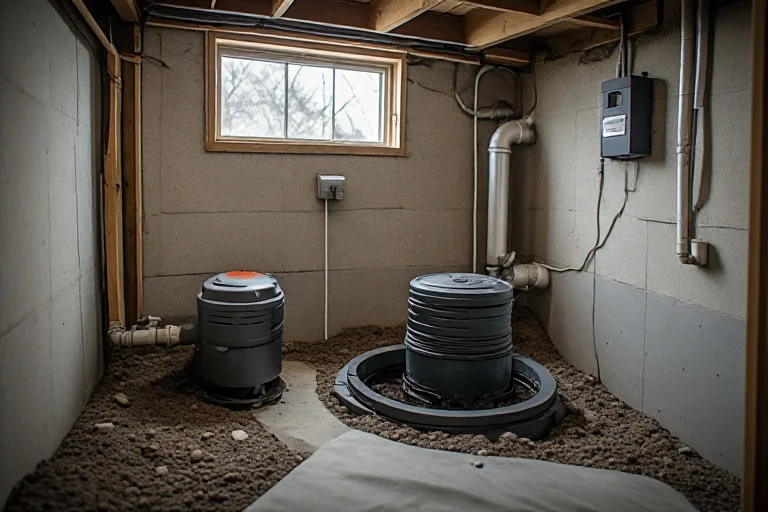
Dropping a new pump into a sound pit is genuinely a weekend job. Parts run $150 to $500. Bring a wrench, a hacksaw and two hours, and you keep the $300 to $600 of labor in your pocket.
Cutting a new pit is a different animal. It involves concrete saws, a wet vacuum, gravel bedding, pitch on the discharge line and, in most homes, an electrician anyway. Getting the pitch wrong sends water back into the basin and burns out the motor within a season. If you are hiring, our guide to vetting the plumber who does the work covers the questions that separate a solid bid from a cheap one.
What it costs over ten years
| Item | Ten year total |
|---|---|
| Install, submersible in a new pit | $1,500 to $3,000 |
| One mid life replacement | $450 to $900 |
| Electricity at $30 to $50 a year | $300 to $500 |
| Backup battery, swapped twice | $100 to $300 |
| Annual check, every other year | $250 to $700 |
| Total | $2,600 to $5,400 |
Set that against one flooded basement. One event with soaked drywall, ruined flooring and a week of blowers commonly runs past $4,000. Our walkthrough on drying out water damage shows why the cleanup is the expensive half. The math is why plumbers push backups so hard.
The verdict
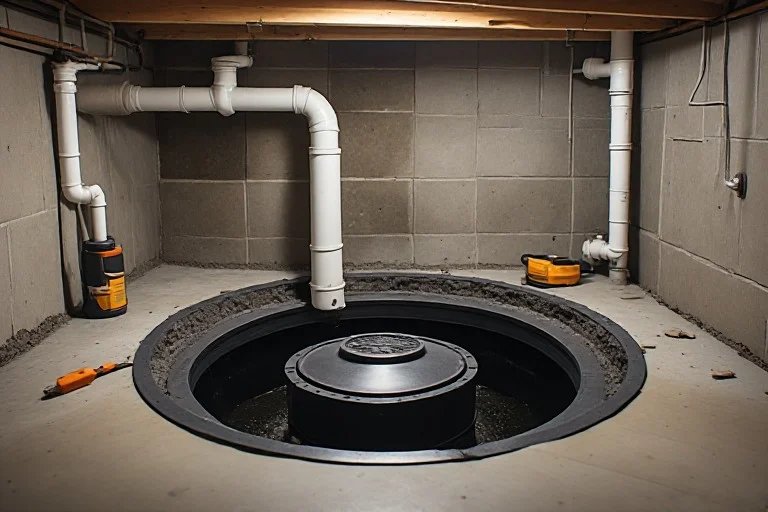
For most homes we recommend a half horsepower submersible in an 18 inch basin with a battery backup. That build lands between $1,600 and $2,600 installed. It is quiet, it clears a storm surge, and it keeps running when the street goes dark.
Choose a pedestal only when the pit is narrow, the water is light and the room is unfinished. Skip smart monitoring at $100 to $500 unless you travel often, since a $30 water alarm tells you the same thing. Whatever you pick, the sump pump installation cost is set more by the hole and the wiring than by the box on the shelf.
Your next step
Get three itemized quotes and make each one price the same setup, half horsepower, sealed lid, backup included. Ask every bidder whether the pit is being reused or cut, since that single answer explains most of the spread between them. Then check the discharge point in the yard yourself before you sign anything.
Frequently Asked Questions
Between $450 and $900 when the pit and discharge line are reusable. That covers the unit, a new check valve and about two hours of labor.
Seven to twelve years for a submersible, longer for a pedestal motor. Units that cycle constantly in wet clay hit the low end of that.
Two hours for a swap. A new pit takes most of a day, with a further day before the concrete patch cures enough for heavy traffic.
One third horsepower handles most dry basements. Move to half horsepower for a high water table, or three quarters where the pit fills faster than 30 gallons a minute.
Yes if your power flickers during storms. Yes twice over if the basement is finished, because the pump is idle exactly when you need it most.