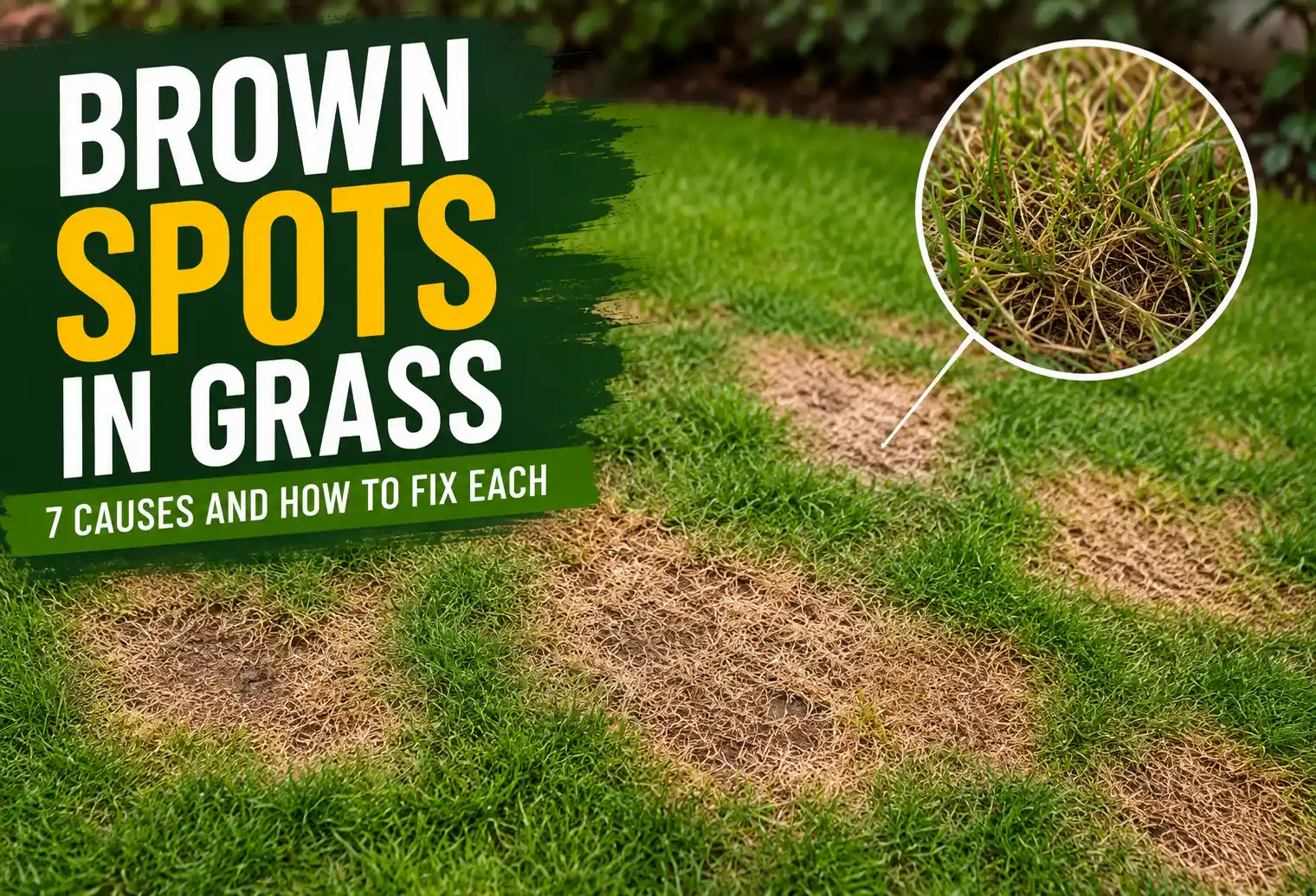
You water the lawn, you feed it on schedule, and a patch goes brown anyway. What makes it maddening is that seven very different problems look nearly identical from the back door. Brown spots in grass caused by a fungus need the opposite care from a patch that is simply dry, so a wrong guess can cost you a season.
The short answer: Brown patches come from seven common causes: brown patch fungus, grubs, dog urine, drought stress, seasonal dormancy, dull mower blades, and fertilizer burn. Patch shape, edge sharpness, the month on the calendar, and a simple tug on the blades separate them in about five minutes, before you spend a dollar.
Key takeaways
- Shape and edge do most of the work. Round spots point at the dog, or a fungus; straight stripes point at the spreader; sprawling areas point at grubs.
- Tug a handful of blades. Turf that peels back like carpet means grubs. Turf that holds firm is dormant, not dead.
- A lawn fading evenly in July, or after the first hard freeze, is dormant and needs no rescue.
- Fungus feeds on nitrogen and evening watering, so fertilizing a fungal patch makes it bigger.
- Most repairs show new green in two to four weeks. Cool-season lawns reseed best in early fall.
What causes brown spots in grass?
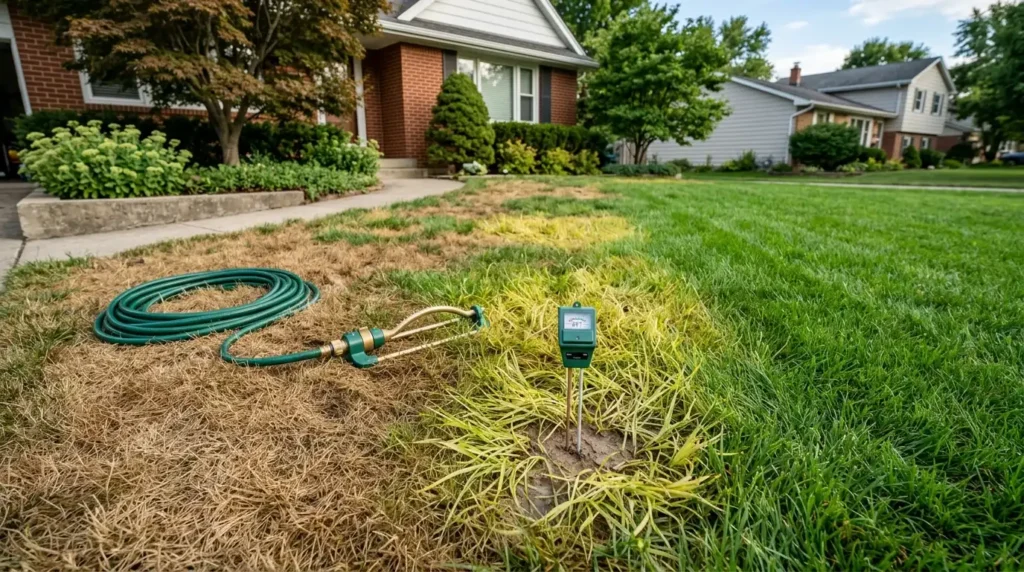
Match your patch against the row that fits, then read across it: edge shape, season, tug result, first move.
| Cause | Patch shape and edge | When it shows | Tug test | First fix |
|---|---|---|---|---|
| Brown patch fungus | Rough circles 6 inches to several feet wide, tan center, darker ring at the edge | Midsummer, humid air and warm nights | Blades pull free, roots stay put | Stop the nitrogen, water at dawn only |
| Dog urine | Round spots 6 to 10 inches across, often ringed in darker green | Any month, worst in heat | Dead center lifts, green ring holds | Soak the spot right away, reseed later |
| Grubs | Sprawling irregular areas that widen week by week | Mid-August into October | Turf rolls back like loose carpet | Count larvae under one square foot |
| Drought stress | Broad pale areas on high ground and beside driveways, gray-blue cast | After two or three dry weeks | Blades hold firm, footprints linger | One inch of water a week, in one soaking |
| Dormancy | The whole lawn fades at once, no real edges | Peak summer heat, or the first hard freeze | Blades resist, crowns still pale green | Nothing. A light watering every two weeks |
| Dull mower blades | No patches at all, a tan haze over everything | A day or two after every mow | Cut tips look shredded and frayed | Sharpen the blade, then mow higher |
| Fertilizer burn | Stripes or streaks with unnaturally straight edges | Two to seven days after feeding | Blades snap, brittle and crisp | Water heavily for a week |
Three checks that settle it in five minutes
Guessing is the expensive part of this. These three checks cost nothing and rule out most of the table above.
- The tug test. Grab a fistful of brown blades and pull gently. If they slide out with no resistance, that crown is gone. If they hold, the plant is alive and probably dormant.
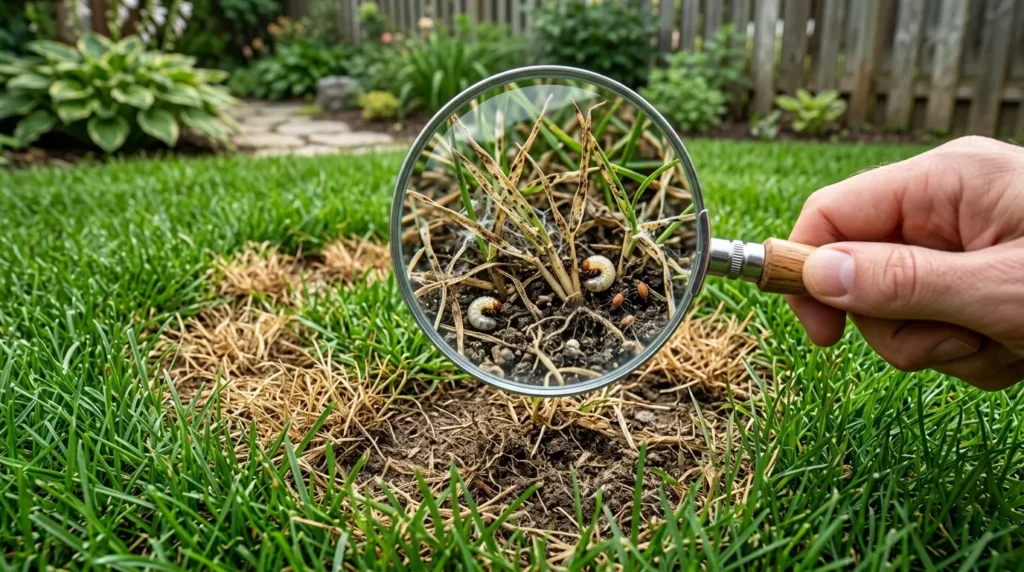
- The spade cut. Slice a one-foot square of sod about three inches deep at the edge of the patch and fold it back. Fat white C-shaped larvae mean grubs, and roots chewed down to stubs confirm it.
- The footprint check. Walk across the pale area in the evening. Footprints that stay visible for several minutes mean the blades are too dry to spring back, which points to water rather than a pest.
Run all three at the edge of the patch, never in the dead middle. That rim is where the problem is still active. When the checks point to deep shade and compacted soil rather than a single bad patch, the real answer is a layout change. These ideas for improving a tired backyard cover that groundwork.
Fungus, grubs and the dog
Brown patch fungus
Brown patch is a midsummer problem driven by heat and humidity. It switches on when nights stay above 68 degrees Fahrenheit and days average 80 or higher, so it arrives in a muggy week and never in May. Tall fescue, perennial ryegrass and bentgrass suffer worst, while Kentucky bluegrass mostly shrugs it off.
Look at the edge for the giveaway. On closely mown turf, you get a darker purplish ring, roughly a quarter to half an inch wide, wrapped around a tan center. Patches run from a few inches to several feet. Heavy nitrogen makes it worse, so a summer feeding is the wrong move here.
Grubs
Grub damage keeps its own calendar. Watch for it after mid-August, though the worst of it often lands in September or even October. This tell is mechanical rather than visual: roots have been eaten off, so the sod lifts away from the soil in loose sheets.
Ten or more grubs under a single square foot will kill the turf above them. Below that number a healthy lawn absorbs the feeding on its own. Skunks and raccoons tearing up the yard overnight are your second signal, since they are digging for those same larvae.
Dog urine
Dog spots are the easiest cause to confirm and the one most often blamed on fungus. They run in circles, roughly 6 to 10 inches across, and many carry a ring of darker green around a dead center. That ring is the proof: diluted nitrogen fertilizes the edge while the concentrated center burns.
Salts cause the damage, not acidity, which is why the vinegar tricks you read about do nothing. Running a hose over the spot within a few minutes dilutes those salts and often saves the plant. Where a dog uses one corner daily, that corner needs sod rather than seed.
The causes you create yourself
Drought stress and dormancy
These two overlap, and separating them decides whether you act at all. Drought stress is patchy. It hits high ground, the strip along the driveway, and anywhere a sprinkler head misses, and the blades turn a dull gray-blue before they brown.
Dormancy is uniform. Every part of the lawn fades at roughly the same rate, the crowns stay firm, and the plant is banking reserves rather than dying.
Leave it be. Pushing a dormant lawn back to green in a hot, dry spell spends reserves it may not recover. A quarter inch of water every two weeks carries it through.
Dull mower blades
This one is not a patch at all, which is why almost everyone misses it. A dull blade tears the leaf instead of slicing it; the torn tips dry out, and your whole yard takes on a tan haze a day after every mow. Kneel down and look at the tips: ragged and whitish means the blade, not the weather.
Sharpen after roughly 20 to 25 hours of mowing, twice a season for most yards. Raise the deck too, because taller blades shade the soil and hold moisture.
Fertilizer burn
Fertilizer burn writes its own confession. Brown follows the path you walked with the spreader, so you get stripes with straight edges, or a scorched square where the hopper sat while you answered the phone.
Damage appears within two to seven days. Water heavily for a week to flush the salts below the root zone, and anything still brown after that needs seed or sod.
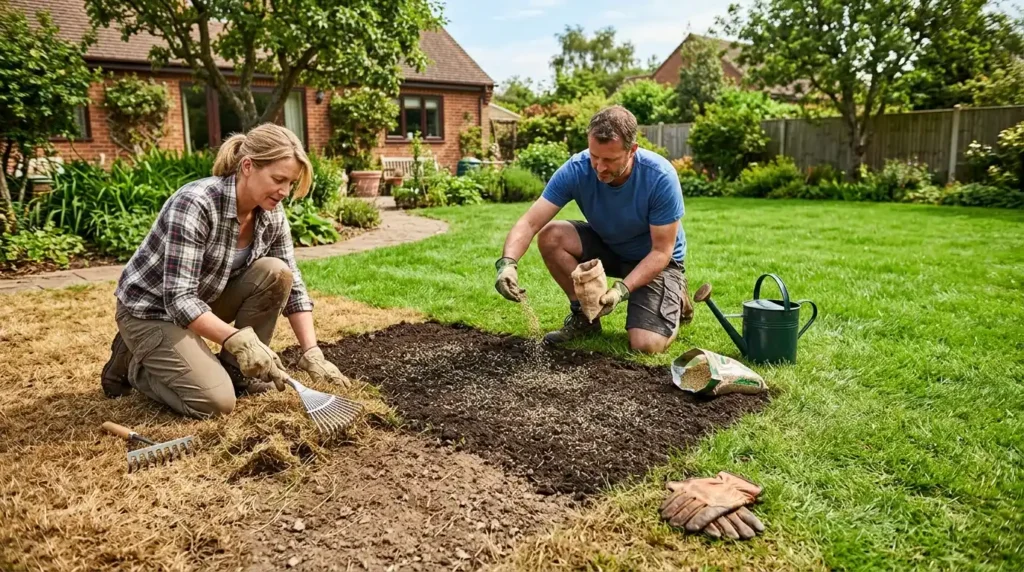
How to repair a brown patch
Once you know the cause, the repair is the same short sequence every time.
- Fix the cause first. Seeding into an active grub population means you’ll get the same patch again in a month.
- Rake out the dead material. Take it down to bare soil. New seed cannot root through a mat of old thatch.
- Loosen the top inch. Scratch the surface with a hand rake so seed meets soil rather than sitting on top.
- Seed or sod. Match what you already grow. Cool-season lawns do best seeded in early fall, warm-season lawns in late spring.
- Water lightly and often. Keep the top half inch damp for two weeks, then taper to one deep soaking.
Expect visible green in two to four weeks, and full knitting-in by the next season. If the same square keeps failing after two honest attempts, the cause is drainage, grading, or shade rather than anything you sprayed. That is the point at which knowing how to choose a landscaping service saves you more than another bag of seed.
When repair keeps failing
Some yards lose this fight for structural reasons. Deep shade under mature trees, a slope that sheds every drop, heavy clay packed down by years of parking: seed fixes none of these. Keep a tally of how often you have repaired the same square, because three rounds in three seasons is a message rather than bad luck.
Your options at that stage are bigger. Regrade and amend the soil, replant with a species suited to the site, or remove the turf and replace it with beds, gravel, or stone. Homeowners in hot climates often weigh the pros and cons of synthetic turf for exactly this reason, especially on a narrow side yard that has never greened up.
Your next step this weekend
Take a spade out to the worst patch and run the three checks. Tug the blades, cut a square of sod and fold it back, then watch whether your footprints linger. Note what you find alongside the month, and match both against the table above. Ten minutes of looking beats a season of guessing.
Frequently asked questions
No overnight fix exists, though you can shorten the wait. Rake out the dead material, water deeply, and reseed with a matching variety. Green returns in two to four weeks once the cause is gone.
Tug a handful of blades. Dormant plants resist, and the crown at the base still looks pale green. Dead plants slide out easily and the crown is brittle. Dormant lawns also fade evenly, while dead ones fail in patches.
Sometimes. Dormancy reverses by itself once rain and cooler weather return, and mild fungal patches often fill in from the edges. Areas killed by grubs, urine salts, or fertilizer burn need reseeding, because those crowns are gone.
Water first in nearly every case, since it helps no matter which cause you land on. Hold the fertilizer until you have ruled out fungus and burn. Save fungicide for a confirmed midsummer fungal patch with that darker ring.
You can, and it works once the cause is handled. Overseeding is wasted on a lawn that still hosts grubs, still gets the same dog visits, or still has a broken sprinkler head.