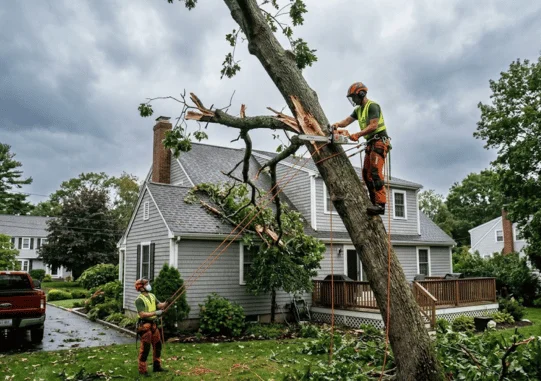
Rhode Island takes a beating every winter. Nor’easters, heavy wet snow, and summer wind storms all leave the same mess in the yard: a cracked limb hanging overhead, a trunk that suddenly leans, or a whole tree down across the driveway.
In that first hour, grabbing a chainsaw feels like the obvious move. That instinct is exactly what sends homeowners to the emergency room every storm season.
This guide walks through the safe order of operations after a storm damages a tree on your property, from the hazards you cannot see to the point where it makes sense to call in a professional.
First, treat every downed wire as live
The most dangerous mistake after any storm is assuming a fallen line is dead. Safety and utility experts are direct about this.
As utility safety guidance makes clear, a power line does not need to spark or hum to be energized. Assume any low, dangling, or downed wire is live, and keep everyone well back.
A wire that looks dead can re-energize without warning as crews restore power, or when a neighbor fires up a generator.
Downed lines can also charge the ground, a chain-link fence, a puddle, or a parked car. Stay clear of anything the wire is touching, and watch for lines hidden under debris.
If a limb or tree is resting on a line, do not touch the tree, the limb, or a pole saw near it. Call 911 for any fire or injury, then call your utility to report the line.
Know which tree is yours to handle
In Rhode Island, responsibility usually comes down to which wire the tree hit.
The utility maintains vegetation around its own pole-to-pole distribution lines, and will often clear a storm-fallen tree off those lines at no charge to you.
The service drop, the wire running from the pole to your house, is generally the homeowner’s side. Damage there is yours to sort out.
Once the line is confirmed de-energized and the area is safe, the removal itself is a job for a crew with a bucket truck, a crane, and trained climbers, not a ladder and a borrowed saw.
This is the point where most homeowners bring in local experts providing Tree Services in Rhode Island because a leaning trunk or a limb under tension behaves in ways that catch people off guard.
The cuts that put homeowners in the hospital
Storm-damaged wood is under stress in ways a standing tree is not, and that changes everything about how it behaves under a saw.
The single most dangerous cleanup mistake is cutting into a limb or trunk that is loaded with tension. A bound-up branch can snap back with enough force to break bones.
Ladders and chainsaws together are a leading cause of storm-cleanup injuries, and a hanging limb can shift or drop long after the wind has stopped.
A partly uprooted tree, or one leaning against your roof or garage, is an active hazard, not a weekend project.
If the tree is large, tangled in a structure, or anywhere near a line, that is where do-it-yourself ends.
Protect your claim before you clean up
Before you move a single branch, photograph everything from several angles.
Cleaning up before you document the damage can complicate or delay a claim, and many policies handle debris removal under a separate, lower limit.
Read the fallen-tree clause in your own policy before assuming the whole bill is covered.
One detail that affects money later: if a tree was already a known hazard before the storm, an insurer can argue the damage was preventable. A tree’s owner is legally responsible for damage or injury caused by a tree that fails, which is why a quick assessment of borderline trees pays off before the next storm, not after.
When Rhode Island law says you need a licensed pro
Rhode Island is stricter than most states about who may work on trees.
State law requires every practitioner of arboriculture to hold a DEM arborist license, and that licensed individual must be on site while the work is done.
That rule exists for exactly the conditions a storm creates: heavy limbs, compromised trunks, and work close to structures or lines.
Before hiring anyone, ask them to confirm a current Rhode Island arborist license. A reputable crew will not blink at the question.
The bottom line
A storm-damaged tree is not the place to test your nerve. Clear the hazards, protect your claim, and let a licensed crew handle the takedown.