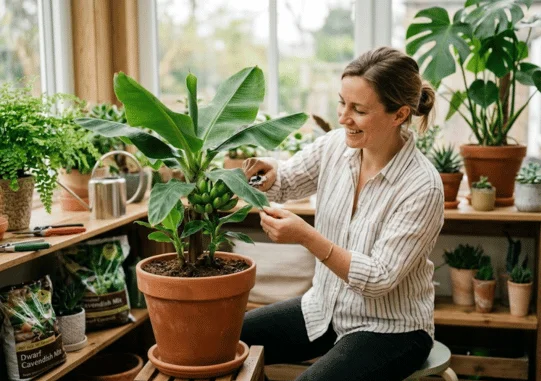
A Dwarf Cavendish banana gets sold three different ways: as a patio fruit tree, as a glossy houseplant, and as the plant behind the fruit in your grocery cart. All three are the same cultivar. What changes is the pot, the light, and the winter, and those decide whether you ever eat anything off it.
The short answer
Grow it in a 15- to 20-gallon pot, give it six hours of direct sun, and keep nights above 60°F. Outdoors in zones 9 to 11 it reaches 8 to 10 feet and fruits in roughly 18 months. Indoors, it stops near 5 feet and rarely fruits at all.
TL;DR
- Direct sun, six to eight hours of it, is the single biggest lever on growth.
- Size up to a 15- to 20-gallon container by year two, or growth stalls.
- Flowering takes 9 to 15 months. Ripening adds another 3 to 6 months on top.
- Fruit under a roof is a long shot. Treat a bunch as a bonus, not a plan.
- Every stem fruits once, then dies. The pups at its base are the next crop.
- Zones 7 and 8 need heavy mulch or a dark garage from November to March.
Dwarf Cavendish Banana Care Specs at a Glance
| Detail | What to give it |
|---|---|
| Botanical name | Musa acuminata’ Dwarf Cavendish’ |
| Mature height | 8 to 10 feet outdoors, 4 to 6 feet in a pot indoors |
| Spread | 5 to 6 feet, so leave elbow room |
| Light | 6 to 8 hours of direct sun, or a south-facing window |
| Water | Deep soak once the top inch dries, often every other day in July |
| Soil | Loose, fast-draining potting mix at pH 5.5 to 7.0 |
| USDA zones | 9 to 11 in the ground, 4 to 11 in a pot you can move |
| Minimum pot size | 15 to 20 gallons for a fruiting plant |
| Temperature range | 65 to 85F, with leaf damage starting below 50F |
| Time to fruit | 9 to 15 months to flower, then 3 to 6 months to ripen |
| Feeding | Balanced fertilizer every 2 to 4 weeks in the growing season |
Indoors, outdoors, or a bit of both?
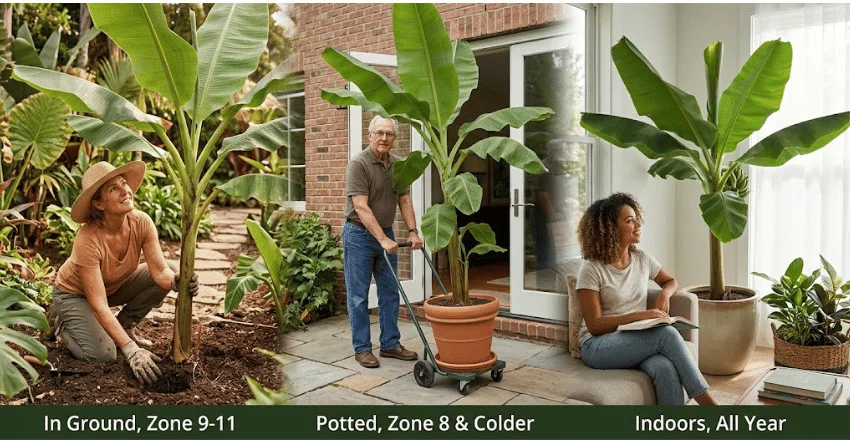
This one keyword hides three different searchers, so let’s resolve the split up front. One wants a dramatic houseplant. Another is after an in-ground plant for a warm yard in zones 9-11. A third is simply curious whether the fruit is real. Sort yourself now, because the care splits three ways from here.
Zone 9 and warmer: put it in the ground, in the sunniest spot you have that is sheltered from wind. Those big paddle leaves shred in a stiff breeze, and a shredded leaf feeds the plant less. Weigh drainage, wind, and afternoon shade before you dig, much as you would when mapping out zones in your outdoor space.
Zone 8 and colder: keep it potted on a wheeled plant caddy. It lives outside from late spring through fall, then comes in before nights drop under 50F.
Indoors all year: you are growing foliage. A happy specimen throws a new leaf every week or two in summer, settling at 4 to 6 feet. Fruit is possible. Probable it is not, and the odds are further down this page.
Light, water, and feeding
Light is where most owners quietly lose. Six hours of direct sun is the floor, and anything less buys a slow plant with small, pale leaves. An east window keeps it alive. A south window, or a spot under a grow light, pushes it.
Water deeply, then let the top inch dry before going again. In a hot July, that can mean every other day; in January, it can mean once every ten days. Standing water in the saucer, not thirst, is the reliable killer here, because it rots the rhizome from underneath. Has yours already sat wet? Drainage fixes of the kind people use when restoring a flood damaged plot work just as well in a container. Get air back to the roots first.
Feeding is heavy. Give a balanced liquid fertilizer every two to four weeks from March to September, then ease off through winter as growth slows.
Pot size and repotting, by age
Almost every guide skips the numbers, so here they are. Container size is the difference between a 4-foot ornament and a flowering plant.
- Nursery plant, first 6 months: 2-3 gallons.
- Months 6 to 12: 5 to 7 gallons. Young plants often need two moves in one year.
- Year two: 15 to 20 gallons, which is the minimum for flowering. A 20-gallon fabric pot costs around $25, and a half whiskey barrel runs $60 to $90.
- Year three onward: stop sizing up. Top-dress with 2 inches of fresh mix each spring, and refresh the whole pot every second year.
Repot in spring, never in midwinter. Roots circling the drainage holes, water running straight through, or a stalled stem all say the same thing: it needs more room.
Will a Dwarf Cavendish Banana Fruit Indoors?
Honestly, rarely. In our experience, roughly one indoor plant in ten ever flowers, and those live in sunrooms or under strong supplemental lighting. A normal room with one window gives you a handsome plant and no bunch.
Outdoors in a warm zone, the timeline runs like this. A strong pup flowers 9 to 15 months after planting. That flower stalk then takes 3 to 6 months to fill out and ripen, longer if nights turn cool. Call it 18 to 24 months from purchase to harvest under good conditions, and add a year or more indoors.
Three conditions decide it: eight or more hours of bright light, steady warmth above 65F, and a pot big enough to carry the weight of a crop. Miss one and the plant grows leaves instead. Humidity helps too, so a pebble tray earns its keep in a dry, heated house.
You do not need a second plant. Fruit sets without pollination and comes out seedless, which is exactly why the ones you buy have no pits in them.
Pups: which to keep and which to cut
The Dwarf Cavendish Banana has a main stem that is not a true trunk but a pseudostem made of packed leaf bases; it fruits once before dying back, while new pups provide continuity.
Treat the suckers as a system rather than clutter. Keep a rotation of three: one mature stem, one half-grown successor, and one small pup. Cut every other sucker off at soil level with a clean blade. Prefer sword pups, the narrow ones with pointed leaves, and remove the broad-leaved water pups, which feed poorly.
Once a stem has given you its bunch, saw that spent pseudostem down to a few inches and let the remaining suckers take over. Chopping it flush invites rot, so leave a stub.
Want a free plant? Wait until a sword pup stands 12 inches tall, then separate it from the parent with a sharp spade. Take a chunk of rhizome and roots with it, because an unrooted pup rarely makes it. Pot the rooted division straight away and keep it shaded for a week.
Getting through winter in zones 7 and 8
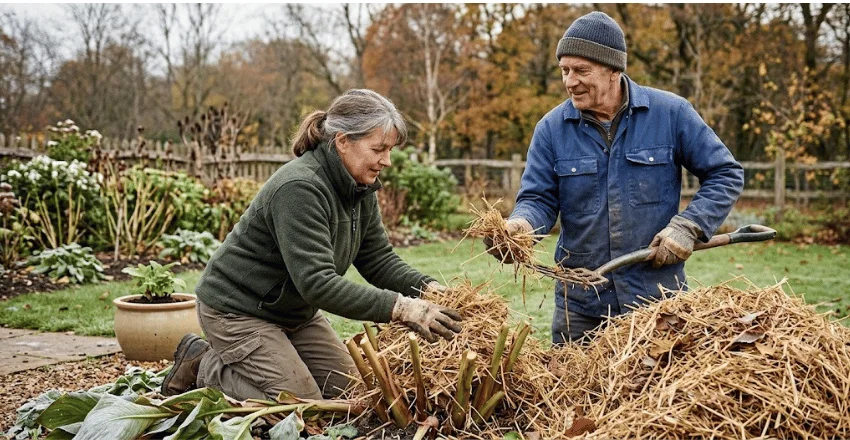
Most guides jump from zone 9 to houseplant care, leaving everyone in between guessing. Leaves collapse at the first frost, but the rhizome survives to roughly 28F, so winter protection is really about the underground part.
In zone 8, cut the stems back to about 2 feet after the first hard freeze and pile 8 to 12 inches of mulch or straw over the crown. In zone 7, dig the rhizome instead. Shake off any loose soil, let it dry for a day, then store it in a box lined with barely damp wood shavings in a garage or basement at 45 to 55F. Check it monthly and mist only if it shrivels.
Potted Dwarf Cavendish Banana plants have it easiest: bring the container in before nights drop below 50°F, place it by your brightest window, and water it half as often.
Pests and the usual problems
Indoor plants get spider mites, invited by dry, heated air. Look for fine webbing where the leaf meets the stem, then rinse both leaf surfaces in the shower weekly for a month. Aphids and mealybugs turn up outdoors and rarely need more than insecticidal soap.
Yellow lower leaves mean overwatering or hunger, in that order. Brown crispy edges mean dry air or salt buildup, and a good flush with the garden hose fixes the second. Outdoors, the fix is usually ecological rather than chemical, and the idea of keeping yard pests in balance beats reaching for a spray bottle every time something chews a leaf.
How it differs from a red banana and a grove plant
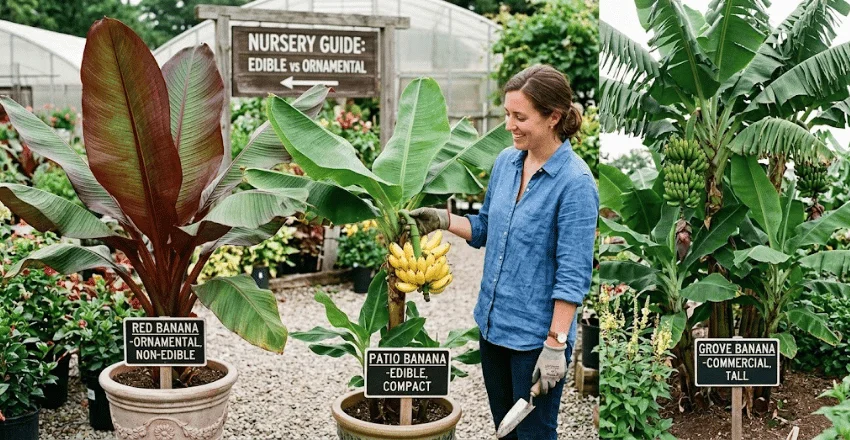
Two mix-ups cost people money. That ornamental red plant sold alongside it, usually Ensete ventricosum ‘Maurelii’ or Musa ‘Siam Ruby’, earns its place with burgundy leaves but offers nothing edible. Gorgeous, yes. A crop, no.
Second mix-up: the commercial grove. Plantations mostly run Grand Nain, a taller relative that hits 12 to 16 feet and needs machinery. Your patio version is the same flavor in a body that fits through a doorway.
Your next step
Start with the pot, because it is the decision everything else hangs off. Measure your sunniest spot, buy the biggest container that fits, and size up before summer. Do that, keep it warm and fed, and a Dwarf Cavendish banana will pay you back in leaves within weeks and possibly in fruit within two years.
Frequently asked questions
Plan for 4 to 6 feet in a container, with a leaf spread of about 5 feet. Exceptional plants in sunrooms have reached 8 feet or more. The name refers to stem height, by the way, not fruit size.
Yes, and it is the same sweet dessert type sold in stores. Homegrown bunches usually carry smaller, softer fingers with more flavor. Cut the whole bunch when the fruit plumps up and the ridges soften, then ripen them indoors.
No. One plant is enough, since the fruit develops without pollination. Extra plants give you more bunches, not better odds on a single one.
Check drainage first. Soggy roots yellow the lowest leaves within a week or two. Otherwise, the plant is hungry, so feed it and check that the pot is not packed solid with roots.
Twice a year while young, then every spring until it reaches a 15- to 20-gallon pot. After that, swap the top 2 inches of mix annually instead.