How to Make Concrete:
Mixing your own batch is one of the few building jobs where math beats muscle. Get the proportions right, and the slab outlives you. Get them wrong and a garden path crumbles by its third winter. This guide covers how to make concrete from raw bags, what a batch yields, and when the truck wins.
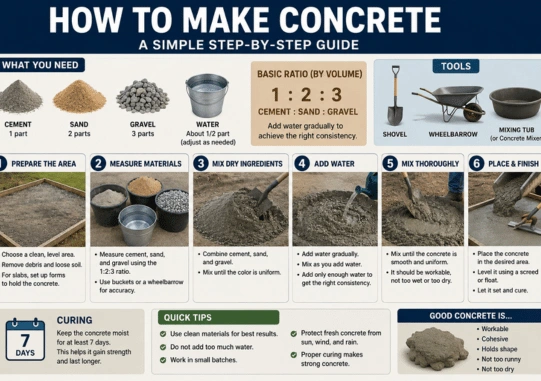
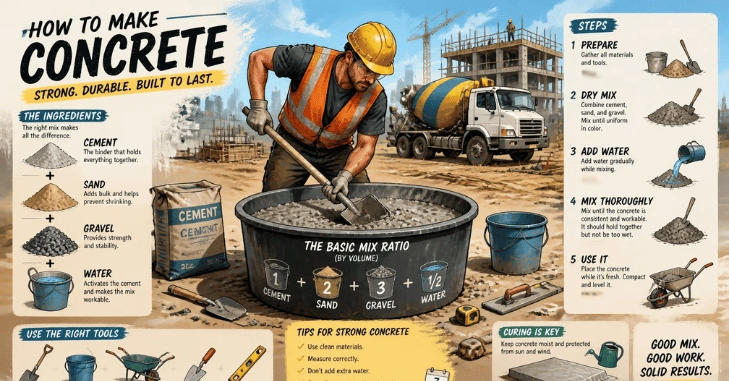
Short answer: combine one part Portland cement, two parts sand, and three parts gravel by volume, then add clean water until the mix holds its shape without slumping flat. That ratio gives roughly 3,500 psi. One 94-lb bag of cement mixed 1:2:3 yields about 4 cubic feet, and the finished pour must stay damp for a week.
| Mix (cement: sand: gravel) | Typical job | Strength at 28 days | Water per 94 lb cement sack | Yield per batch |
| 1:3:6 | Fill, bedding, non-structural pads | about 2,000 psi | 6 gallons | about 6.5 cubic feet |
| 1:2:4 | Sidewalks, garden paths, shed bases | about 3,000 psi | 5.5 gallons | about 4.6 cubic feet |
| 1:2:3 | Driveways, footings, steps | 3,500 to 4,000 psi | 5 gallons | about 4 cubic feet |
| 1:1.5:3 | Garage floors, heavy loads | 4,500 to 5,000 psi | 4.5 gallons | about 3.6 cubic feet |
One batch here means one 94-lb sack of cement plus its matching amounts of sand and stone. That last column is the part almost nobody prints. Sand slips into the voids between the stones as you turn the pile, so a batch finishes at roughly two-thirds of the loose volume that went into the wheelbarrow.
The water column matters just as much. Half the weight of the cement, near 5 gallons per sack, puts the water-to-cement ratio at 0.5, which is the sweet spot for a hand-mixed pour. Every extra gallon past that buys you an easier pour and costs you a few hundred psi.
TL;DR: The Numbers That Matter
- 1:2:3 by volume, cement to sand to gravel, is the everyday mix for driveways and footings.
- Water sits near half the weight of the cement, roughly 5 gallons per 94 lb bag.
- Expect a batch to finish at about two-thirds of the loose dry volume you started with.
- A cubic yard takes 45 of the 80 lb premix bags, 60 of the 60 lb bags, or 90 of the 40 lb bags.
- Keep the surface damp for 7 days. Full design strength lasts 28 days.
- Under half a cubic yard, bags win on price. Past 1.5 cubic yards, call a ready-mix truck.
Cement, Mortar, and Concrete Are Not the Same Thing
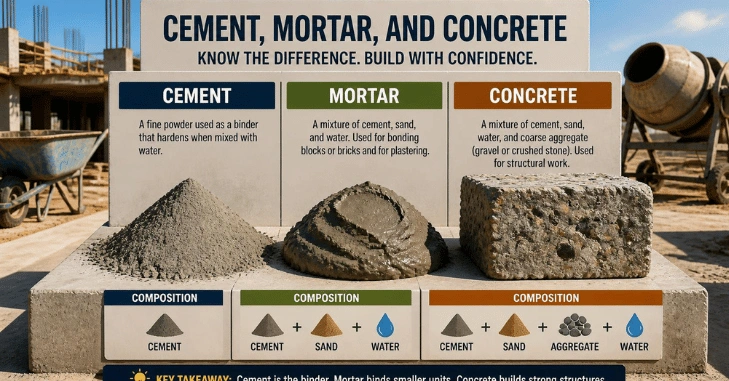
How to make concrete Cement is a gray powder, and on its own it acts as glue rather than as a building material. Stir that powder into sand and water, and you get mortar, the stuff that beds brick and block. Add gravel to the same mixture, and you get the structural material that fills forms and carries a car.
Stone does the heavy lifting here. Cement paste only coats the pieces and locks them together, so a batch with no stone in it shrinks more, costs more per cubic foot, and ends up weaker. That is why a sack labeled “mortar mix” is the wrong buy for a slab, and why that trip back to the store is so common.
Four ingredients go in, and each one carries a spec worth respecting.
- Portland cement: Type I or Type I/II, the ASTM C150 gray powder sold in 94 lb sacks.
- Sand: washed coarse sand. Play sand is too fine, and beach sand contains salt, both of which weaken the bond.
- Gravel: clean crushed stone, with 3/4 inch as the standard size for a home pour.
- Water: clean enough to drink. Pond water carries organic matter that stalls the set.
Mix Ratios and What Each Batch Yields
You measure the ratio by volume, not by weight, so one bucket is the only measuring tool you need. Use the same bucket for every dry ingredient and the proportions look after themselves. Water is the exception, and you count it in gallons, because a few splashes too many cost real strength.
Work Out How Much You Need
Multiply length by width by thickness, all in feet, and you have the volume. A 10-by-10 pad at 4 inches thick works out to 33 cubic feet, or 1.2 cubic yards. Order 10 percent more than that, because forms bulge and no base is perfectly level.
Premix is sold by weight, so the conversion you need is from bags per yard. Seeing a patio pour counted in bags makes the job’s size obvious.
| Bag size | Yield per bag | Bags per cubic yard | Bags for a 10 by 10 pad at 4 inches |
| 40 lb | 0.30 cubic feet | 90 | 110 |
| 60 lb | 0.45 cubic feet | 60 | 74 |
| 80 lb | 0.60 cubic feet | 45 | 55 |
Fifty-five bags means 4,400 lb to haul and stack, which is where plenty of people rethink the whole plan. If you are still weighing up surfaces for that space, our guide to flooring options for a patio or pool deck is worth reading before you build a single form.
Tools and Gear to Set Out First
- Wheelbarrow or mixing tub, plus a square shovel or a mixing hoe
- Two five-gallon buckets, one to measure with and one for water
- A rented mixer for anything over about 15 cubic feet
- Screed board, wood float, steel trowel, and an edger
- Gloves, eye protection, long sleeves, and rubber boots
Wear the gloves and the eye protection. Wet cement is caustic and can burn skin after long contact, so rinse splashes off with clean water the moment they land. Never kneel in a fresh pour.
How to Make Concrete Step by Step
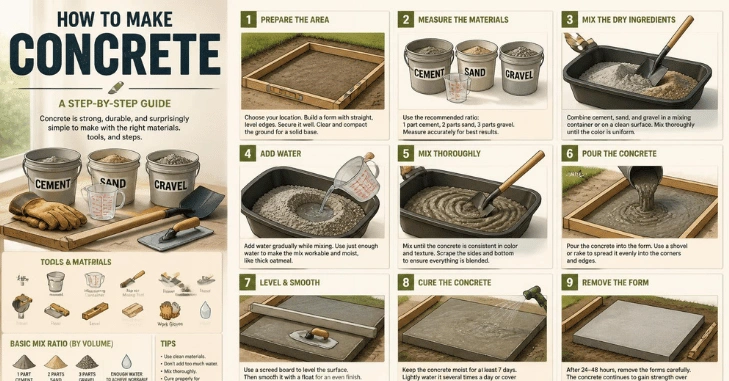
- Measure the job. Multiply length by width by thickness in feet, then add 10 percent for waste.
- Pick the ratio. Match it to the load from the table above and choose the bucket you will measure with.
- Lay out the gear. Park the barrow on level ground within your reach, then pull on gloves and eye protection before you open a sack.
- Prep the base and forms. Compact 4 inches of gravel, stake 2-by-4 forms to the finished height, and dampen the base so it cannot steal water from the batch.
- Dry mix first. Turn the cement, sand, and stone together until the color runs one even gray with no streaks left.
- Add water in stages. Pour in about 90 percent of your water, fold the dry corners inward from the outside, then trickle in the rest.
- Test the consistency. Scoop a bucketful, flip it upside down on a board, lift the bucket, and read the slump.
- Place and finish. Fill the forms in one continuous session; saw a screed board across the tops; float once the surface sheen fades; then edge it and cut control joints.
Step 7 distinguishes a strong pour from a weak one and takes 30 seconds. The mound should sag an inch or two and keep its shoulders. Spreading into a puddle means there’s too much water, so turn in a few more shovels of sand and stone, then test it again.
Hot Weather and Cold Weather Change the Recipe
Temperature drives the chemistry, and most guides skip it entirely. Above 85 F, the batch stiffens fast, so start early and soak the forms beforehand. Have a helper mist the surface while you finish. You lose working time in that heat, sometimes half of it.
Cold brings the bigger problem. Below 50 F, the set slows to a crawl. A pour that freezes during its first 24 hours can lose half its strength permanently. If below 40°F, mix with warm water and cover the surface with insulating blankets. Postpone the job outright if a hard freeze is in the three-day forecast. Skip the folk remedies too. Rock salt and antifreeze cause damage, while a calcium chloride accelerator sold for the job is added at the mixer.
Curing: The Week That Decides the Result
Curing is not drying, and the difference costs people real money. The batch gains strength through a moisture-dependent reaction, so a slab left to dry out for two days stops getting stronger. Keep it wet for a full seven days, either by misting twice daily under plastic sheeting or by laying wet burlap over the top.
Light foot traffic is fine after 24 to 48 hours. Give it 7 days before furniture goes on, 10 days before a car does, and 28 days for full design strength. Slow, damp curing is also the cheapest crack-prevention option, and the rest of that technique is in our notes on keeping a new slab from cracking.
When Bagged Premix Beats Mixing From Scratch
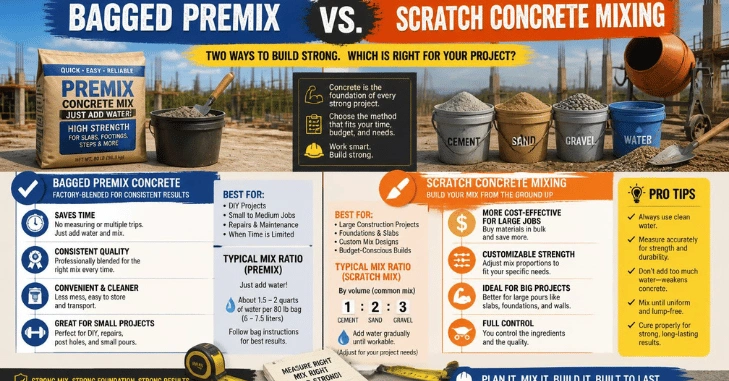
Premix already contains cement, sand, and stone in the right proportions, so it only needs water. You pay for that convenience. At $6 to $9 a bag, a cubic yard of premix runs $270 to $400. Buying the raw ingredients separately drops the same yard to roughly $150-$250. Ready-mix from a truck lands near $160 to $220 a yard, plus a short load fee of $60 to $150 under three yards.
Volume decides the whole question.
- Under half a cubic yard: post holes, a small pad, and a repair. Buy bags every time, because consistent proportions and zero leftovers beat the price per yard.
- Half a yard up to 1.5 yards: mix from scratch and rent a mixer, usually $60 to $90 for the day.
- Past 1.5 to 2 cubic yards: order the truck. Hand mixing a driveway turns into a two-day slog you regret by hour four.
One more option deserves naming. Anything that has to finish dead flat, polished, or poured indoors is worth handing over. The case for bringing in a polished-floor contractor grows as the area expands.
Your Next Step
How to make concrete Measure the space today and run the numbers through the yield table above. Write your bag count down before you go shopping. Then mix one test batch, leave it a week, and hit the edge with a hammer. Hear a sharp ring instead of a crumble, and your ratio is right so that the real pour can go ahead.
FAQ
Four things. Portland cement and water make the paste, while sand and gravel make the body. The paste coats every grain and stone, then hardens the whole mass into one piece.
You can, but what you get is mortar rather than a structural material. Without stone, the batch shrinks more and cracks sooner, so keep the sand-only version for bedding brick.
Around 5 gallons per 94-lb sack, which puts the water-to-cement ratio near 0.5. Damp sand already holds water, so start low and add the last half-gallon slowly.
Twenty-four to 48 hours for light foot traffic. Wait a week before putting furniture on it, and 10 days before you park anything on it.
Your own wins under about a cubic yard and loses badly above it. Once a full day of labor and a mixer rental are factored in, learning how to make concrete from scratch pays off mostly on small and medium jobs.
Use 1:2:3 for a driveway poured 4 to 6 inches thick. A patio slab that only carries chairs and people does fine on 1:2. 4.