
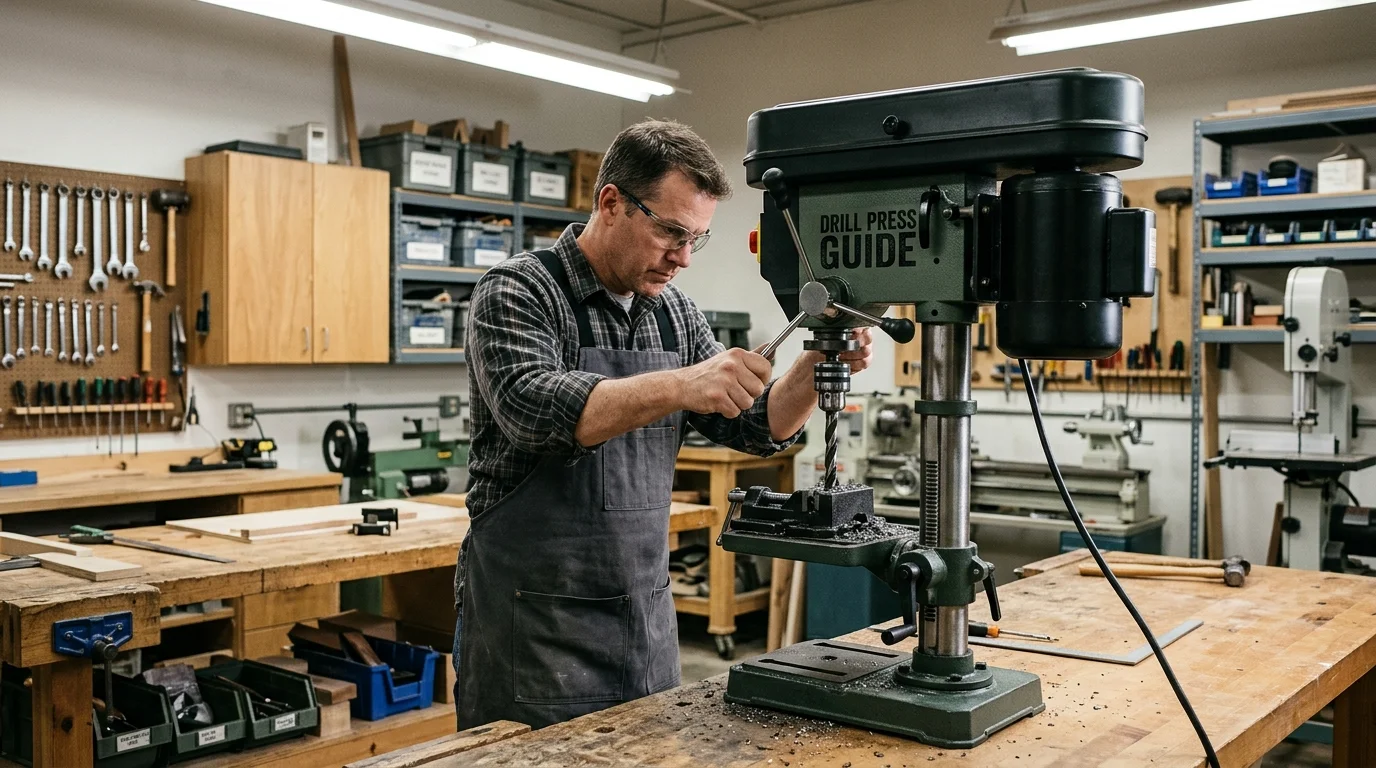
A drill press gives home workshops something a handheld drill struggles to provide: controlled, repeatable drilling. The fixed spindle helps keep holes straight and makes consistent depths easier. Choosing the right machine depends on your projects, materials, available space, and required capacity.
Quick answer: A drill press is a stationary drilling machine built for accurate, repeatable holes in wood, metal, and other materials. Most home workshops suit a benchtop model. Larger projects may justify a floor-standing machine with greater swing, spindle travel, power, and low-speed capability.
| Feature | What It Means | Why It Matters |
|---|---|---|
| Swing | Twice the distance between spindle and column | Determines workpiece width capacity |
| Spindle travel | Maximum downward spindle movement | Determines drilling depth per pass |
| Speed range | Available spindle speeds | Helps match speed to material and bit |
| Chuck capacity | Range of bit shank sizes accepted | Determines compatible tooling |
| Table | Surface supporting the workpiece | Affects support and positioning |
| Depth stop | Limits downward spindle movement | Helps produce repeatable hole depths |
| Benchtop design | Mounts on a workbench | Saves floor space |
| Floor design | Stands independently | Provides more capacity for larger work |
What Is a Drill Press?
A drill press holds a rotating bit in a chuck above an adjustable work table. You lower the spindle using a feed handle while the workpiece remains supported below. This arrangement improves control compared with freehand drilling.
The machine is useful when several holes need matching positions, angles, or depths. Woodworkers use it for furniture parts, dowel holes, and larger boring operations. Metalworkers value its controlled feed, adjustable speed, and stable workholding.
Most conventional machines include a base, column, table, head, motor, spindle, and chuck. Many models also provide adjustable depth stops and several spindle speeds. Some newer machines offer variable-speed controls or digital speed displays.
Why Use One Instead of a Handheld Drill?
A handheld drill remains better for portability and work on large fixed objects. A stationary machine becomes useful when accuracy and repetition matter more than mobility. Its guided spindle removes much of the alignment work from each hole.
Depth control is another major advantage for furniture and repetitive shop projects. You can set a stop and drill several holes to nearly identical depths. That capability is harder to reproduce consistently with a handheld tool.
A stable table also lets you use fences, stops, clamps, and drilling jigs. Those accessories can make repeated parts faster to position. They also reduce the need to measure every hole separately.
Benchtop vs. Floor-Standing Models
| Type | Best Suited For | Main Advantages | Main Trade-Offs |
|---|---|---|---|
| Benchtop | DIY, woodworking, smaller parts | Compact, lighter, usually less expensive | Less vertical capacity |
| Floor-standing | Large workpieces, frequent shop use | Greater capacity and larger working area | Requires more space |
| Radial | Specialized positioning work | Greater spindle positioning flexibility | More complex and less common |
| Magnetic | Field metalwork | Can attach directly to suitable steel | Designed for specialized metal applications |
Benchtop machines make sense for many American garages and home workshops. They occupy less space and can handle common woodworking or repair jobs. A strong workbench is important because the machine needs a stable mounting surface.
Floor models provide more room between the chuck, table, and base. That extra height helps when drilling taller parts or handling larger projects. Their extra size matters less when your projects stay small.
RoomDome readers building a workshop can also review its Garage section for related workspace ideas. Good machine selection starts with understanding the space surrounding the tool. Leave enough room for stock, clamps, lighting, and safe operator movement.
Drill Press Specifications That Matter Most

Specifications can look impressive without telling you whether a machine fits your projects. Pay particular attention to swing, spindle travel, speed, and table design. Start with physical capacity before comparing convenience features.
Swing
Swing describes twice the distance between the spindle center and the nearest column edge. It indicates how wide a workpiece can be for centered drilling. For example, greater swing provides more reach toward the middle of wider material.
Don’t treat a larger swing as automatically better. Extra capacity usually means a larger machine and greater space requirements. Measure your typical workpieces before deciding what you need.
Spindle Travel
Spindle travel describes how far the spindle can descend during one feed movement. More travel lets you drill deeper holes without repositioning the table or workpiece. This measurement matters for thick lumber and deeper boring operations.
Think about the thickest material you expect to drill regularly. Then compare that requirement with each machine’s stated travel. Buying around real projects prevents paying for unused capacity.
Speed Range
Different materials and bit diameters require different spindle speeds. Small bits generally operate faster than large-diameter cutting tools. Metal drilling also often requires lower speeds than comparable woodworking operations.
A broad speed range therefore makes a machine more adaptable. Traditional belt-driven models require pulley changes for different speeds. Variable-speed machines can make frequent adjustments more convenient.
Chuck Capacity
The chuck holds the drill bit or other compatible cutting tool. Its listed capacity tells you which shank sizes it can accept. Check your existing bits before purchasing a machine.
Chuck quality also affects how securely a bit remains centered during operation. A poorly seated or damaged bit can create visible runout. Clean mating surfaces and install it correctly to preserve accuracy.
How to Choose a Drill Press for Your Workshop
Start by listing what you plan to build, not by comparing motor numbers. Write down your usual materials, largest workpiece, and deepest expected holes. This simple exercise immediately rules out many unsuitable machines.
Next, decide where the machine will permanently live. Measure available bench space, floor space, and overhead clearance. Remember that long boards may require considerably more side clearance than the machine itself.
Then compare capacity specifications against your project list. Prioritize swing, travel, useful speed range, table support, and overall rigidity. Features such as lasers and work lights should come after those fundamentals.
Your storage layout deserves similar planning. RoomDome’s guide to choosing garage tool cabinets covers capacity, durability, stability, and workspace organization. Keeping bits and accessories nearby can make a fixed drilling station easier to use.
Features Worth Paying Attention To
A depth stop is valuable when several holes must finish at the same depth. Adjustable tables help support different workpiece sizes. Tilting tables can help with angled work when the project requires it.
Variable speed becomes more useful when you frequently change materials or bit diameters. Belt-driven speed changes remain perfectly workable for less frequent adjustments. Consider convenience against added purchase cost and mechanical complexity.
Integrated lights can improve visibility around layout marks and drilling points. Laser guides may help with rough alignment but don’t replace careful setup. Accurate work still depends on proper marking, clamping, and machine alignment.
Setting Up a Safe Home Workshop
Place the machine on a solid surface before using it. Secure a benchtop unit according to the manufacturer’s instructions. Floor machines also need stable positioning and adequate working clearance.
Always secure small or awkward workpieces rather than holding them loosely by hand. A suitable vise or clamp helps resist the rotational force created during drilling. Remove the chuck key before starting any machine that uses one.
Eye protection is essential because drilling can produce chips and broken fragments. Loose clothing, jewelry, and unsecured long hair can become entangled in rotating parts. Follow the manufacturer’s manual for setup, speed selection, maintenance, and permitted accessories.
Workshop organization also affects safe movement around stationary equipment. RoomDome’s Crafts and Tools section provides more material on home projects and tool-related tasks. Plan storage so frequently used accessories stay accessible without crowding the machine.
Choosing Bits for Wood and Metal
Twist bits cover many everyday holes in wood, plastic, and metal. Brad-point bits can provide cleaner positioning in woodworking. Forstner bits are useful when you need larger, clean-sided holes in wood.
Large cutting diameters usually call for lower spindle speeds. The correct setting also depends on material, bit design, and manufacturer guidance. Don’t assume one speed works for every operation.
Metalworking introduces additional considerations, including cutting speed and workholding. Suitable cutting fluid may be recommended for certain materials and operations. Follow the bit and machine manufacturers’ instructions rather than guessing a setting.
Maintenance That Protects Accuracy
Remove chips and dust after finishing your work. Debris around the table and moving components can interfere with clean setups. Keeping exposed metal surfaces dry also helps limit corrosion.
Inspect the chuck, belts, fasteners, and table adjustments periodically. Belt condition and tension can affect operation on pulley-driven machines. Address unusual vibration before continuing work.
Check alignment when holes begin showing unexplained inaccuracies. Problems can come from the bit, chuck, spindle, table, or workholding method. Isolating each factor is more useful than immediately blaming the motor.
Is a Drill Press Worth Buying?
The machine makes the most sense when you regularly need straight or repeatable holes. Furniture building, jig making, fabrication, and repeated drilling can benefit considerably. Occasional household holes may not justify its permanent footprint.
A benchtop model often provides a practical starting point for a home workshop. It keeps floor space available while providing the main benefits of guided drilling. Larger machines become more attractive as workpiece size and drilling demands increase.
Think beyond the machine’s purchase price when planning your setup. You may also need clamps, a vise, suitable bits, and improved lighting. A planned workstation usually provides more value than spending the entire budget on capacity.
Frequently Asked Questions About a Drill Press
What is a drill press mainly used for?
It is mainly used for accurate and repeatable drilling. The guided spindle helps keep the bit aligned while the workpiece stays supported. Depth stops also make it easier to reproduce hole depths.
Is a benchtop model enough for a home workshop?
A benchtop machine can handle many common DIY and woodworking projects. Its main limits involve workpiece height, swing, and spindle travel. Compare those measurements with your planned projects before buying.
Can you use one for metal?
Yes, many machines can drill metal with the right bits and settings. Secure workholding becomes especially important because a bit can grab the material. Use speeds and cutting practices recommended for the material and tooling.
What does swing mean?
Swing is twice the distance from the spindle center to the column. It describes the approximate width capacity for centered drilling. It doesn’t tell you the maximum drilling depth.
Do I need variable speed?
Variable speed is convenient but isn’t necessary for every home workshop. Pulley-driven machines also provide multiple operating speeds. Variable adjustment becomes more useful when you switch materials and bit sizes frequently.
Build the Workshop Around Your Actual Projects
Start with your largest likely workpiece and deepest common hole. Those two measurements quickly narrow the machines worth considering. Then compare speed range, table quality, stability, chuck capacity, and useful convenience features.
Avoid buying capacity because a specification looks impressive on paper. Choose a machine that fits your workspace and the projects you expect to complete. A properly sized stationary drill can provide years of accurate, repeatable workshop work.